Slow Feedback Cycles
Large cohorts and subjective papers make meaningful feedback difficult to return while students can still act on it.
Evaluate large volumes of handwritten examination answers while keeping faculty in control. Analytics come from that evaluation—not instead of it.
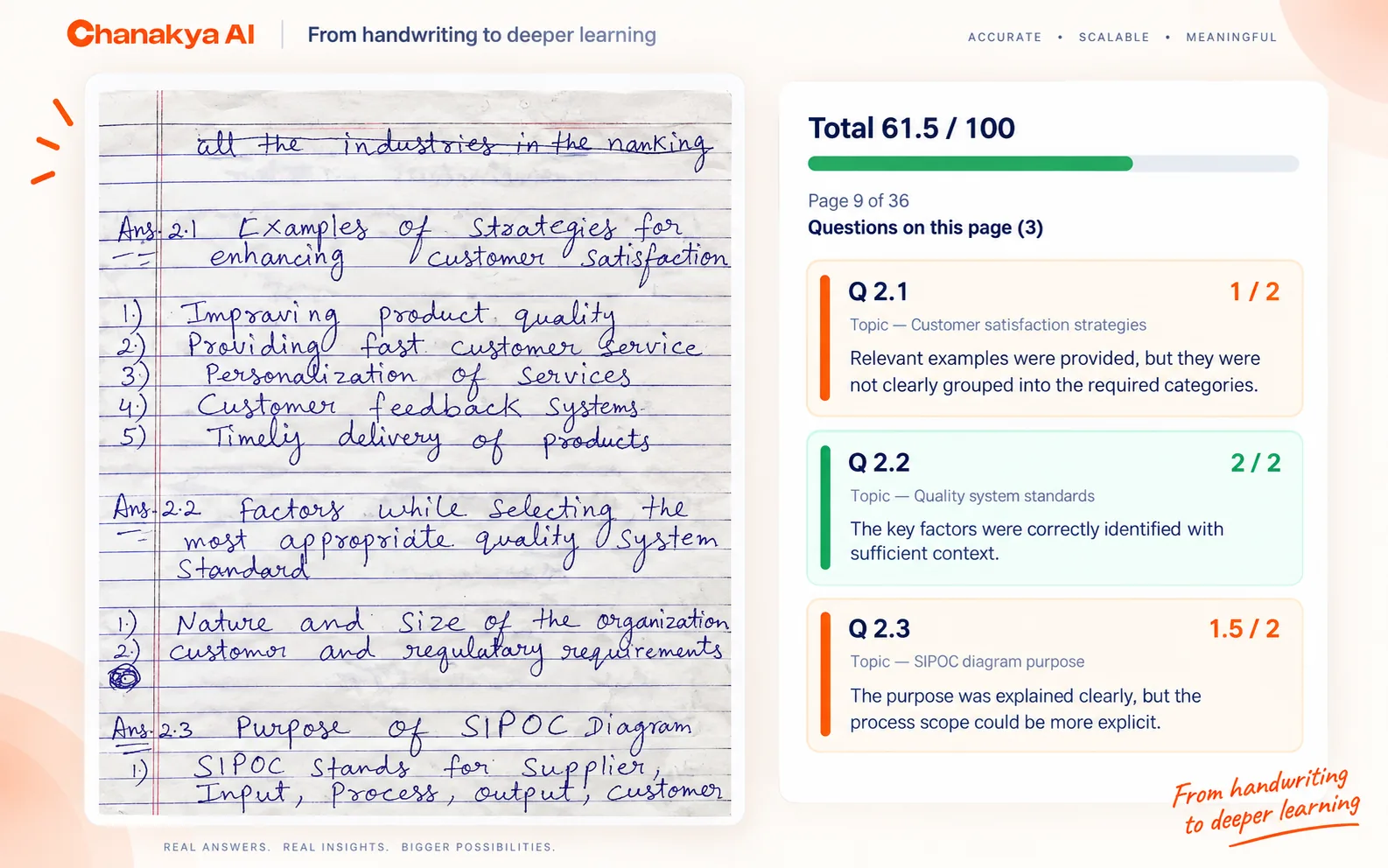
Faculty remain in control
Evaluate the work → Review the marks → Act on the gaps
Already evaluating real student work
50,000+
answer sheets evaluated
200+
question papers generated
The higher-education assessment gap
The challenge is not a shortage of examinations. It is converting a high volume of responses into useful feedback and timely academic action.
Large cohorts and subjective papers make meaningful feedback difficult to return while students can still act on it.
Marks are stored, but misconceptions, reasoning gaps, and question-level patterns are rarely captured at scale.
Evaluation competes with teaching, mentoring, research, administration, and the time needed for targeted intervention.
One connected assessment layer
Chanakya AI adds evaluation assistance and learning analytics to existing assessment workflows while keeping faculty in control.
Digitize and evaluate descriptive answers against faculty-approved rubrics and marking schemes.
Return specific guidance on misconceptions, incomplete reasoning, and the next concepts to revisit.
See difficult questions, weak concepts, cohort patterns, and students who may need timely support.
Apply common rubrics across sections while keeping faculty verification and academic judgment in control.
Add intelligence to handwritten examinations and current academic processes without forcing a complete redesign.
Process multi-section and multi-course answer sheets in batches so large university cohorts can be evaluated without linear faculty overtime.
Define review thresholds, escalation rules, and verification workflows for nuanced or ambiguous responses.
Faculty-verified by design
AI can handle repetitive evaluation work and surface patterns. Faculty remains academically responsible for final marks, nuance, exceptions, and intervention.
Faculty provides the question paper, rubric, and marking expectations.
Collected answer sheets are scanned into a secure evaluation workflow.
AI proposes marks, feedback, and concept-level learning signals.
Faculty reviews exceptions, samples results, and retains final academic authority.
Course insights guide tutorials, revision, mentoring, and curriculum decisions.
Run a focused pilot around a high-volume course, a faculty-approved rubric, and success measures your academic team trusts.
We’ll evaluate a sample of your answer sheets and review the marks and explanations with your academic team.
Universities · Subjective exams · Faculty review